How to Cut Your Power Bill With Smart Energy Monitoring (No Solar Required)
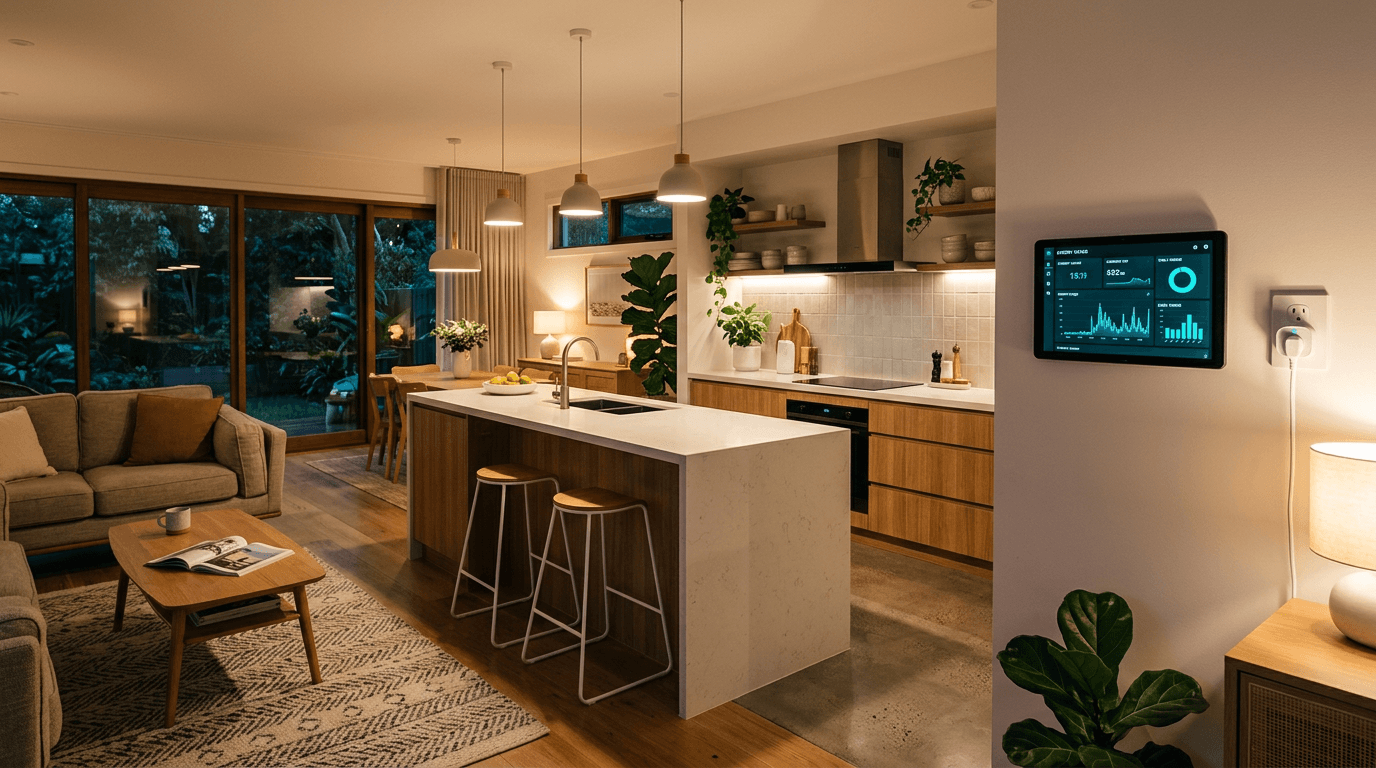
You Can't Save What You Can't See
Here's something most people don't realise: the average Australian household wastes 20-30% of its electricity on things that are either running when they shouldn't be, or drawing power while supposedly "off."
That old bar fridge in the garage. The TV on standby. The bathroom heat lamp your teenager left on six hours ago. The pool pump running at peak tariff.
You probably have a rough idea that these things cost money — but do you know how much? That's the problem. Without real numbers, you're guessing. And guessing doesn't reduce your bill.
Smart energy monitoring changes that. It gives you actual data on what's using power, when, and how much it's costing you — in real time.
What Is Smart Energy Monitoring?
At its simplest, it's a device wired into your switchboard or plugged into an outlet that measures how much electricity is flowing through a circuit. The data is sent to your phone or a dashboard, so you can see exactly what's happening.
There are two levels:
Circuit-Level Monitoring
Devices like the Shelly Plus 2PM install behind your existing switches and measure the power consumption of whatever's on that circuit. You get:
- Real-time wattage — what's being drawn right now
- Historical usage — daily, weekly, monthly consumption graphs
- Cost tracking — set your tariff rate and see dollar amounts, not just kilowatt-hours
This is ideal for monitoring lighting circuits, hot water systems, air conditioning, or any hardwired appliance.
Plug-Level Monitoring
The Shelly Plus Plug S sits between your appliance and the wall outlet. Same real-time monitoring, but for individual plug-in devices — perfect for finding the energy vampires.
The Biggest Energy Wasters in Australian Homes
After helping dozens of households set up energy monitoring, the same culprits come up again and again:
1. Standby Power (the Silent Killer)
Your TV, gaming console, soundbar, set-top box, computer monitor, printer, and phone chargers all draw power 24/7 — even when you think they're off. Individually it's small (5-15 watts each), but add them up across every room and you're looking at $150-300 per year doing absolutely nothing.
The fix: A Shelly Plus Plug S on your entertainment unit lets you kill power to the whole lot with one tap — or schedule it to cut at midnight and restore at 6pm. Total cost: under $40. Pays for itself in 2-3 months.
2. Old Fridges and Freezers
That second fridge in the garage or the chest freezer you keep "just in case" can draw 3-5x more power than a modern unit. We regularly see bar fridges costing $200-400/year to run.
The fix: Plug it into a smart plug, monitor it for a week, and see the actual cost. Many families discover it's cheaper to buy a new efficient fridge than to keep running the old one for another year.
3. Hot Water Off-Peak Timing
If you're on a time-of-use tariff, your hot water system timing matters enormously. Running it during peak hours (2pm-8pm) can cost double compared to off-peak.
The fix: A Shelly Plus 1 on your hot water circuit gives you scheduling control. Heat water during off-peak or solar hours, not when electricity costs the most.
4. Pool Pumps
Pool pumps are one of the biggest single loads in a home — 1,000 to 2,000 watts for 6-8 hours a day. Running during peak tariff vs off-peak can mean a difference of $500+ per year.
The fix: Smart scheduling with a Shelly Plus 1 ensures your pump runs during the cheapest hours. Some families shift their entire pump schedule to early morning and cut their pool running costs in half.
5. Heating and Cooling
Air conditioning is the big one. A ducted system can draw 5-10kW. The difference between running it efficiently (targeted rooms, scheduled times) versus leaving it on all day is hundreds of dollars per quarter.
The fix: Smart monitoring shows you exactly what your AC costs per hour. That data alone changes behaviour — when you can see it's costing $3.50/hour, you're more motivated to dress warmly or use a fan.
Real Numbers: What Monitoring Actually Reveals
Here's what a typical monitoring setup shows in the first week:
| Discovery | Typical Saving | |-----------|---------------| | Standby power across entertainment + office | $150-300/year | | Old fridge/freezer running inefficiently | $200-400/year | | Hot water shifted to off-peak | $100-200/year | | Pool pump rescheduled | $300-500/year | | Lights left on in empty rooms (automated off) | $50-150/year | | Total potential saving | $800-1,550/year |
These aren't theoretical numbers. They're what we consistently see when families start measuring instead of guessing.
Getting Started: The $40 Experiment
Before you commit to monitoring your whole house, try this:
Step 1: Get a Shelly Plus Plug S — under $40.
Step 2: Plug your TV/entertainment setup into it.
Step 3: Check the app after one week.
You'll see exactly how much power your entertainment gear draws on standby versus when it's actually in use. For most families, this single discovery is enough to justify monitoring every major circuit in the house.
Scaling Up: Whole-Home Monitoring
Once you've seen the data from one plug, the natural next step is monitoring your main circuits. Here's the practical approach:
Priority Circuits to Monitor
- Hot water — biggest single load for most homes
- Air conditioning / heating — seasonal but enormous when running
- Pool pump (if applicable) — easy to optimise with scheduling
- Kitchen circuit — fridge, dishwasher, oven
- General power / lighting — catch the standby vampires
What You Need
- Shelly Plus 2PM for dual-circuit monitoring (handles two circuits per device, with power metering on both)
- Shelly Plus 1 for single circuits where you want on/off control plus monitoring
- Shelly Plus Plug S for individual appliances you want to measure or schedule
The Network Foundation
All these devices connect via WiFi. If your WiFi is patchy (especially at the switchboard, which is often in a garage or laundry), you'll want solid coverage first. A Ubiquiti U7 Pro access point ensures your smart devices stay connected reliably — no dropouts, no missed schedules.
Time-of-Use Tariffs: Why Timing Is Everything
If you're on a time-of-use electricity plan (and most NSW households are or can switch), when you use power matters as much as how much you use.
Typical NSW tariff structure:
- Off-peak: ~$0.20/kWh (10pm-7am, weekends)
- Shoulder: ~$0.28/kWh (7am-2pm, 8pm-10pm weekdays)
- Peak: ~$0.45/kWh (2pm-8pm weekdays)
That means running your pool pump at 3pm costs more than double compared to running it at 6am. Same electricity, same result, completely different cost.
Smart switches let you automate this shift without thinking about it. Set it once, save money every single day.
"But I Have Solar..."
Solar is fantastic — but it doesn't eliminate the need for monitoring. In fact, it makes monitoring more valuable:
- See your actual self-consumption — how much solar are you using vs exporting?
- Shift loads to solar hours — run the dishwasher, washing machine, and pool pump when the panels are producing
- Identify overnight waste — solar doesn't help at 2am when your standby loads are quietly draining grid power
- Maximise your investment — if you're exporting at $0.05/kWh and buying back at $0.35/kWh, every kilowatt you shift to daytime saves $0.30
What This Actually Costs
Let's be honest about the investment:
| Setup | Cost | Expected Annual Saving | |-------|------|----------------------| | 1x Smart Plug (experiment) | ~$40 | $150-300 | | 3x Smart Relays (hot water, pool, AC) | ~$120 | $500-900 | | 2x Smart Plugs (entertainment, office) | ~$80 | $200-400 | | 1x WiFi Access Point (reliable network) | ~$430 | — | | Typical whole-home setup | ~$670 | $850-1,500/year |
Most families see a full return on investment within the first year. After that, it's pure savings — every year, automatically.
Professional installation by a licensed electrician is recommended for switchboard devices (that's what we do). Smart plugs are plug-and-play.
The Bottom Line
Energy monitoring isn't about sacrificing comfort. It's about stopping waste you didn't know existed.
The average Australian household pays $1,800-2,500 per year on electricity. Our experience shows that smart monitoring and automation typically cuts that by 30-40% — without changing your lifestyle, just your timing and awareness.
Start with one smart plug. Look at the data. Then decide how far you want to go.
Want help setting up energy monitoring in your home? Get in touch — we'll assess your switchboard, recommend the right devices, and handle the installation.